
SPEnviroWatch — Business Case & Investment Prospectus
Executive Summary
SPEnviroWatch is an operational civic technology platform that enables communities to report, track and resolve local environmental issues — from fly-tipping to water pollution. Built and deployed by Sustainable Planet SCIO, the platform is live at enviro.sustainableplanet.co.uk and requires seed investment of £11,000 to transition from a working prototype to a fully supported community service with paid coordination, formal council partnerships, and a structured outreach programme.

By Year 3 the platform is projected to be financially self-sustaining through a combination of local authority licensing agreements, grant income, and corporate CSR sponsorship — while remaining permanently free to every member of the public.
The Problem
Environmental enforcement in the UK is chronically under-resourced. Local authorities collectively spent £392 million on street cleansing in 2022–23, yet the volume of reported fly-tipping has increased year-on-year for the past decade, with over one million incidents recorded annually in England. Scotland sees over 60,000 incidents per year, the majority in rural and semi-rural areas where enforcement presence is minimal.
The reporting mechanisms available to the public are fragmented, inconsistent, and frequently ineffective. Different councils use different portals. Many have none at all. Reports submitted by well-intentioned residents often disappear into administrative backlogs with no acknowledgement and no visible outcome. Community trust in the reporting process erodes, engagement falls, and the environment suffers.
The Solution
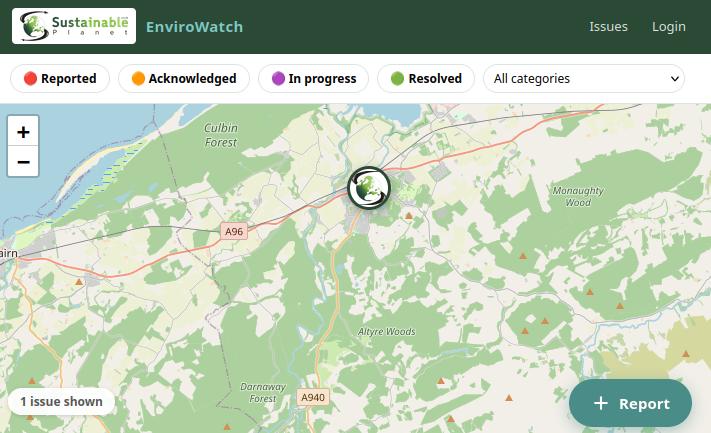
SPEnviroWatch provides a single, consistent reporting interface that works across all local authority boundaries. A report takes under two minutes. The platform automatically identifies the responsible authority via the UK postcode API, creates a permanent geo-tagged record with photographic evidence, and makes it visible to a network of community volunteers who can investigate, update, and escalate reports.
The technology stack — Vue.js front-end, Node.js API, MySQL database, Leaflet mapping — is modern, maintainable, and deployable at very low cost. The platform currently runs on shared hosting at approximately £50 per month.
Market Opportunity
The primary addressable market is the 317 local authority areas across England, Scotland, Wales and Northern Ireland. Secondary markets include national parks, community land trusts, housing associations, and environmental NGOs seeking structured community engagement tools.
The civic technology market in the UK is growing. Central government and the Scottish Government's community empowerment agenda have explicitly identified community-led digital reporting tools as a funding priority. The timing for SPEnviroWatch is strong.
Operating Model
SPEnviroWatch operates on a freemium civic model:
• Free tier (always): Any member of the public can report an issue at no cost and with no account required. This is a core commitment and will never change.
• Council partnership tier: Local authorities pay an annual licensing fee (proposed £500–£1,500 per year depending on population size) to receive structured data exports, integration with their own CRM systems, and a branded portal. In return they commit to acknowledging and responding to reports within a defined SLA.
• Grant funding: Applications to environmental and community benefit funds covering operational costs, outreach events, and coordinator salaries.
• Corporate CSR sponsorship: Companies with environmental or community commitments sponsor regional coverage areas, contributing £1,000–£5,000 per year in exchange for recognition and impact reporting.
Financial Projections
Year 1 — Establishment (Seed Funding Required: £11,000)
Year 1 is focused on stabilising the platform, recruiting the first cohort of community monitors, establishing three pilot council partnerships, and building the evidence base required for Year 2 grant applications.
| Cost Item | Annual Cost |
|---|---|
| Server hosting and infrastructure | £600 |
| Domain, SSL and third-party APIs | £150 |
| Development (part-time contractor, 80 hrs) | £4,800 |
| Community outreach events × 6 | £1,800 |
| Marketing and communications | £600 |
| GDPR compliance and data protection | £800 |
| Administration and insurance | £500 |
| Contingency (10%) | £750 |
| Total Year 1 | £10,000 |
Year 2 — Growth (Grant-Funded Target: £18,000)
| Cost Item | Annual Cost |
|---|---|
| Infrastructure (scaled for growth) | £1,200 |
| Part-time platform coordinator (0.25 FTE) | £7,500 |
| Development (continued) | £4,000 |
| Outreach events × 12 | £3,600 |
| Authority partnership development | £1,200 |
| Total Year 2 | £17,500 |
Year 2 income target: £18,000 (council licences £4,500 + grant income £10,000 + sponsorship £3,500)
Year 3 — Sustainability (Self-Sustaining Target)
| Income Stream | Projected Income |
|---|---|
| Council licensing (10 × avg £1,200) | £12,000 |
| Grant income | £10,000 |
| Corporate sponsorship (3 sponsors) | £6,000 |
| Total Income | £28,000 |
| Total Operating Cost | £22,000 |
| Projected Surplus | £6,000 |
Volunteer Structure
Volunteers are the engine of SPEnviroWatch. Without engaged local people, reports go uninvestigated and the feedback loop that sustains community participation breaks down. We have defined five volunteer roles, each with a clear time commitment and a specific function.
Community Area Monitor (target: 50 volunteers)
The core frontline role. Monitors adopt a defined geographic patch — typically a village, town ward, or rural road network. They check the platform map weekly, investigate new reports in their area, post photographic updates, and flag issues that require authority escalation. Time commitment: 1–2 hours per week.
Regional Coordinator (target: 5 volunteers)
Coordinators support a group of eight to twelve area monitors. They run monthly catch-up calls, help resolve escalation situations, report on activity to Sustainable Planet, and identify areas with coverage gaps. Time commitment: 3–4 hours per week.
Authority Liaison (target: 10 volunteers)
Individuals with existing relationships with local authority staff — former councillors, community council members, residents association chairs — who can open doors to formal partnership conversations and follow up on escalated reports. Time commitment: as needed.
Outreach Event Volunteer (target: 20 volunteers)
People willing to help deliver community awareness events — setting up, demonstrating the app, answering questions, and helping attendees make their first report. Events typically run two hours. Volunteers are asked to commit to at least two events per year.
Technical Contributor (target: 5 volunteers)
Developers, designers, or data professionals who contribute to platform development. Work is managed via a shared repository. Areas of need include mobile UX improvements, council API integrations, accessibility audit and remediation, and data visualisation.
Funding Sources We Are Pursuing
• The National Lottery Community Fund — Awards for All Scotland (up to £20,000, ideal for Year 1)
• Scottish Government Environment Fund (community environmental projects)
• Climateaction.tech Community Grants (civic technology for environmental impact)
• Highland Council Community Benefit Fund (renewable energy local benefit funds)
• Moray Community Fund (local voluntary sector grants)
• Garfield Weston Foundation (environment and community programmes)
• Corporate CSR partnerships (utilities, telecoms, supermarkets with Scottish operations)
Risk and Mitigation
| Risk | Likelihood | Mitigation |
|---|---|---|
| Low public adoption in early areas | Medium | Targeted outreach events; school partnerships; local press |
| Council reluctance to partner | Medium | Pilot data from volunteer-led areas; peer council referrals |
| Volunteer drop-off after initial enthusiasm | Medium | Coordinator layer; recognition programme; monthly impact updates |
| Grant funding delayed or unsuccessful | Low–Medium | Multiple concurrent applications; low Year 1 cash requirement |
| Data protection / GDPR incident | Low | Privacy by design; minimal data collection; legal review Year 1 |
The Ask
We are seeking £11,000 in seed funding to deliver Year 1 of this plan. This covers twelve months of infrastructure, a contracted development sprint to harden the platform for wider use, six community outreach events, GDPR compliance work, and the administrative foundation needed to pursue Year 2 grant applications from a position of evidenced activity.
The annual cost of running SPEnviroWatch is less than the cost of two weeks of a single council enforcement officer. Community intelligence, properly organised, is the most cost-effective environmental tool available to us.